Summer Interns 2026
Insights from Our Summer Students
This summer, we welcomed two interns to the John Adams Institute. Here, they share their experiences, reflect on what they have learnt, and offer insights into their time working with us.
Katie Skilling
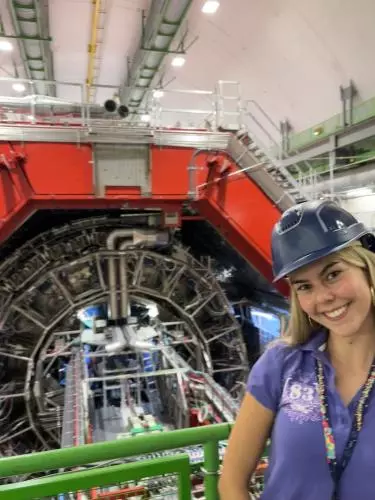
I have recently completed my internship with the John Adams Institute, where I had a great time working at the CLEAR facility at CERN. My project, supervised by Dr Alexander Malyzhenkov, involved optimising the currents in the quadrupoles located between an RF transverse deflecting cavity and a YAG screen, in order to achieve the best temporal resolution for electron bunch length measurements. To achieve this, I created a beam transport simulation in Python for a section of the CLEAR beamline. This simulation was then compared to experimental measurements, which were obtained through hands-on accelerator operation. The best experimental resolution I achieved was 0.16ps.
Then, I extended the simulation to cover the rest of the mainline and the dogleg, investigating how the different lattice elements affect the evolution of the electron beam's 6D phase-space correlations.
I really benefited from this amazing opportunity to spend a summer at CERN, work alongside research professionals and meet lots of lovely people, so thank you to everyone that helped make it such an enjoyable experience!
Traian Tus
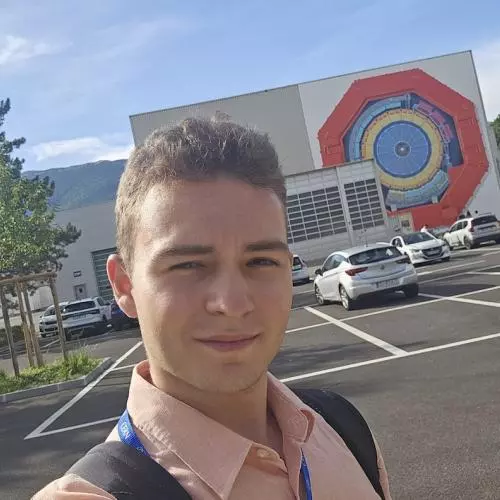
Investigating a novel approach to radiotherapy is no easy task. Yet after spending a full summer at CLEAR, working alongside some of the most phenomenal minds in the field – from learning the principles of accelerator dynamics and beam diagnostics to developing new dosimetry techniques – I have come to appreciate the major impact that research at CERN can have far beyond fundamental physics.
More specifically, my work explored how the acoustic characterization of Very High Energy Electron (VHEE) beams could facilitate accurate ultra-high dose-rate (UHDR) delivery for the treatment of deep-seated tumours.
I investigated several approaches to correlating delivered dose with the acoustic waves generated inside a water phantom simulating biological tissue. This involved a broad range of beam-monitoring techniques, position scans, radiochromic film dose calibrations, temperature and waveform studies, and beam-control measurements on key samples, among many others. Overall, the combination of data analysis, experimental work and applied physics contributed towards the development of a modern online dosimetry method for the extreme irradiation conditions in which conventional methods can become unreliable.
After the long hours, experiments and many beamline operations, I must thank the CLEAR team for all the support they provided throughout this experience. In particular, my supervisor, Alexander Malyzhenkov, for constantly guiding my work and helping me navigate the scientific details; Wilfrid Farabolini, for his invaluable experimental expertise; Camilla Giaccaglia, Sabrina Wang and Giacomo Tangari, whose support enabled important parts of my study; Antonio Gilardi and Julie Lascaud, with whom the research direction was developed; Ciara Moore, Sara Simonsson and Katie Skilling, for the ongoing teamwork; as well as Roberto Corsini and Davide Gamba, for their support with the wider programme and administration.
It was an immense pleasure to be part of CERN and the John Adams Institute for Accelerator Science, and to contribute to research aimed at making a meaningful difference.